Reality exists in stratified layers independent of our knowledge of it
Critical Realism
Critical Realism
A philosophy of science that separates two dimensions: the intransitive (structures that exist whether we know them or not) and the transitive (our theories and knowledge practices). This separation lets CR be realist about what exists while acknowledging that our knowledge is socially shaped, theory-laden, and fallible.
Core features:
- Reality is stratified into irreducible levels
- Mechanisms generate events; we observe some events as experiences
- Mechanisms have causal powers that operate independently of observation
- Higher-level properties emerge from lower levels without being determined by them
Knowledge never directly mirrors reality, yet can still refer to and explain real structures.
Why Critical Realism?
My computer science undergrad and my cognitive science lab experience equipped me with a standard scientific realist view. Theories get tested, falsified, refined. Reality is out there to be discovered through experiment.
For my Social Science Diploma, my initial research plan was to study cognitive mechanisms in individuals and scale them up to explain social phenomena.
Then I read Durkheim in a social theory course. Social facts are sui generis. Suicide rates, institutional structures, collective representations have causal powers that don’t reduce to individual psychology. You can’t explain them by aggregating individual cognition.
This broke my scaling-up project plan. This kind of broke my epistemology and I am the type of person who becomes disoriented if there is no coherence. What do you mean it can’t be reduced to individual cognition? That’s what I do in lab.
Around the same time, I took a critical epistemology course and read Crotty’s Foundations of Social Research. The interpretive social science arguments were convincing. Knowledge is theory-laden, observation isn’t neutral, research is always positioned. But again I was also collecting mousetracking data and epistemological anarchism was deeply uncomfortable to me.
Critical realism resolved both tensions. Ontological stratification means social structures and cognitive mechanisms are both real at different levels. Structures emerge from individual actions but constrain them. Mechanisms enable individuals to navigate structured contexts. Neither reduces to the other. And epistemological fallibilism means I can be realist about both while acknowledging my knowledge is situated and theory-laden.
Both my experimental work and ethnographic work became coherent within the same framework.
Bhaskar’s Stratified Reality
Critical realism distinguishes three nested domains of reality.
The Real contains all mechanisms, structures, and causal powers, whether or not they’re activated. Cognitive architectures, social structures, chemical bonds exist independently of producing observable events.
The Actual is where mechanisms activate and events occur. A neuron fires, a market crashes, someone makes a lexical decision, whether or not anyone observes them.
The Empirical is what we can observe and measure. Always smaller than the Actual (we miss most events) and vastly smaller than the Real (most mechanisms remain dormant or unobservable).
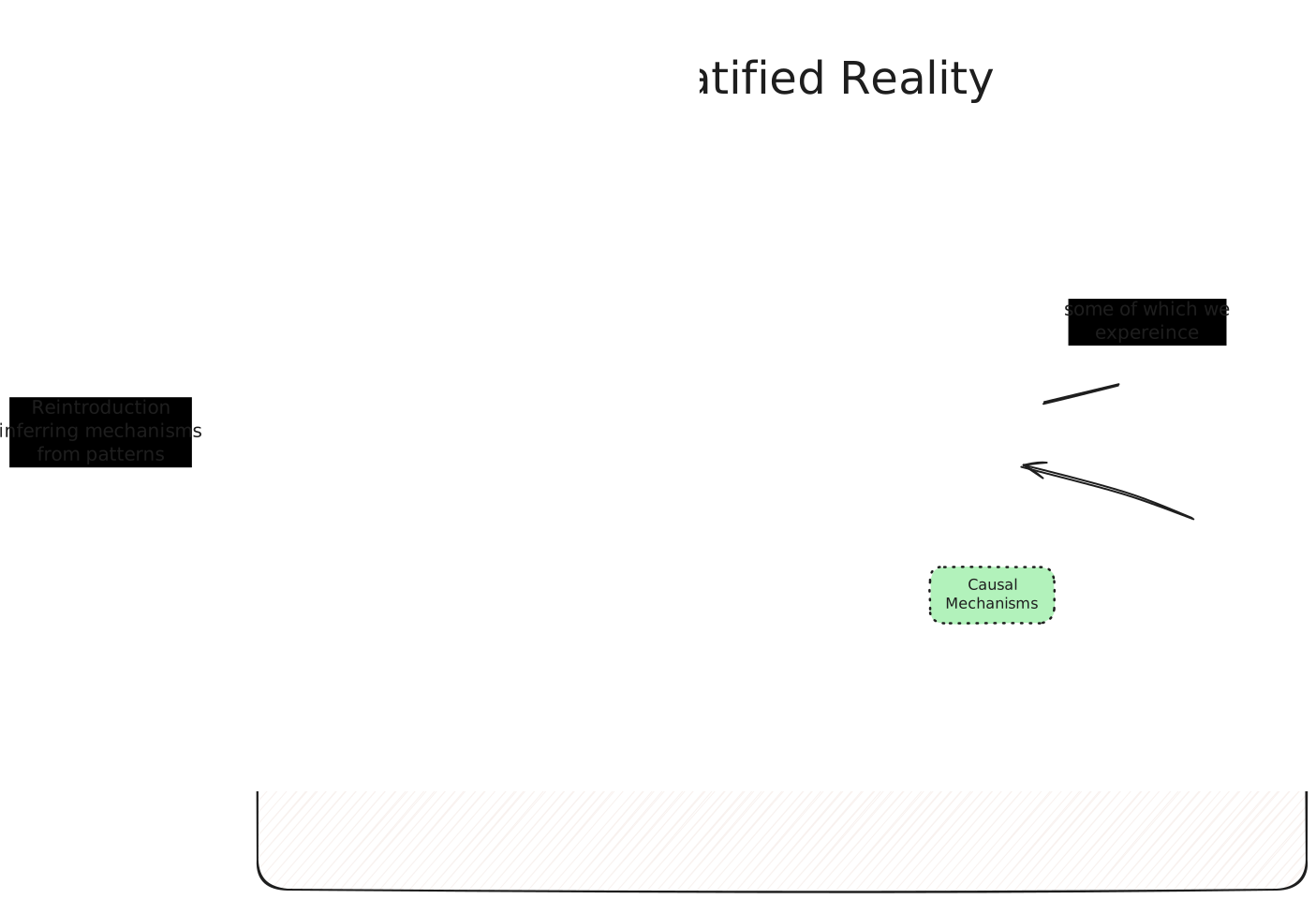
These domains correspond to three ontologically irreducible aspects:
Structures (mechanisms in the Real) are generative mechanisms with causal powers: cognitive architectures, social relations, material processes. They exist whether activated or not.
Events (occurrences in the Actual) happen when structures activate under specific conditions. They occur in time, whether observed or not.
Experiences (our access through the Empirical) are our observational encounters through measurement and perception. They appear to us, always partially.
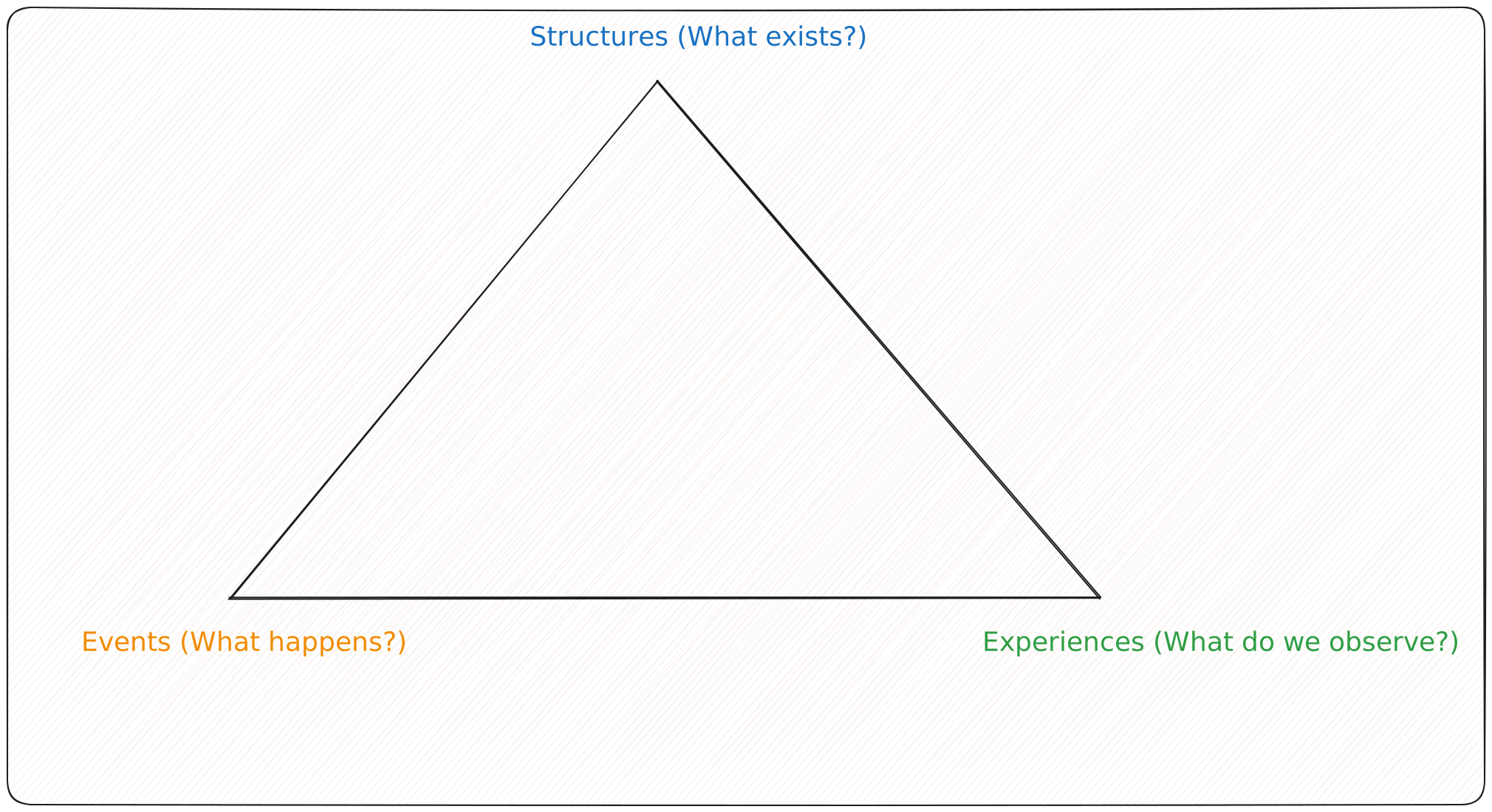
Retroduction moves between these levels: observe patterns in experiences, infer events, reason backwards to mechanisms. Mousetracking reveals cognitive processes. Ethnography reveals social structures. Science moves from surface to depth.
Why This Matters for Research
All three aspects are real and none reduces to the others. Structures have causal powers even when I’m not measuring them. Events occur whether I observe them or not. My experiences provide partial access to both.
This lets me be realist about cognitive mechanisms I infer from mousetracking data while acknowledging the inference is fallible. It lets me be realist about social structures I document ethnographically while acknowledging my account is positioned. The mechanisms and structures are real. My knowledge of them is partial. Both claims hold simultaneously.