Earn your abstractions: immerse until proposals are warranted, not just compatible
Premature optimization is the root of all evil. - Knuth
I knew this advice yet couldn’t stop myself from repeatedly violating it. On ideations and hackathons, while doing experimental cognitive science and ethnographic social science - I encountered this failure mode everywhere. I used to get the same recurring feedback on my early ethnographic writing : it’s good but try to immerse more.
Looking back I agree with it, I used to jump from thing to thing. I remember saying that focusing on a thing diminishing returns what’s the point of staying stagnant. I didn’t understand. I had observations. I’d linked them to theory. What was missing?
The abstraction is earned through abduction: proposing structure, then testing it. I was running abduction without inputs.
The Loop
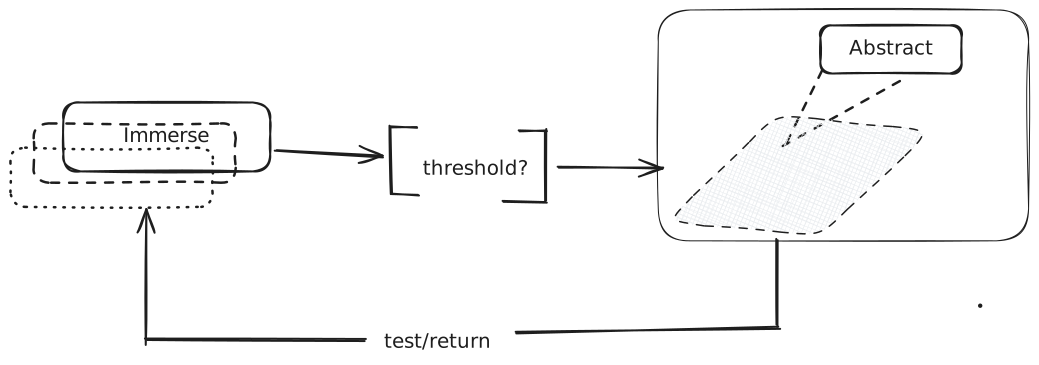
Three modes of inference
Deduction applies structure: theory → instances. You already have the pattern; you’re checking if cases fit.
Induction extracts structure: instances → pattern. You let regularity “emerge” from data. Grounded theory works this way.
Abduction proposes structure: surprise → what would make this unsurprising? You encounter something that doesn’t fit your current models. You invent a structure that would explain it. Then you test whether that structure holds.
Abduction is the creative move. It’s also the one most vulnerable to running on empty.
What abduction needs
A proposed structure is cheap. Even without enough material, any pattern can be made to feel like insight. But what’s constraining the proposal? What would surprise you if the structure were right? (Not “falsify.” I’ve moved past folk Popperianism. But the intuition holds: your proposal should make predictions that could update you.)
Premature abduction = f( , )
Run it with empty arguments and you get noise dressed as insight.
Immersion fills in the arguments: instances, variation, anomalies, whatever the domain demands. Enough exposure that your proposal is forced by what you’ve seen, not merely compatible with it.
Without this, abduction is just pattern-matching against imported theory. Your observations become decoration for conclusions you already held.
The threshold
When is abduction accountable?
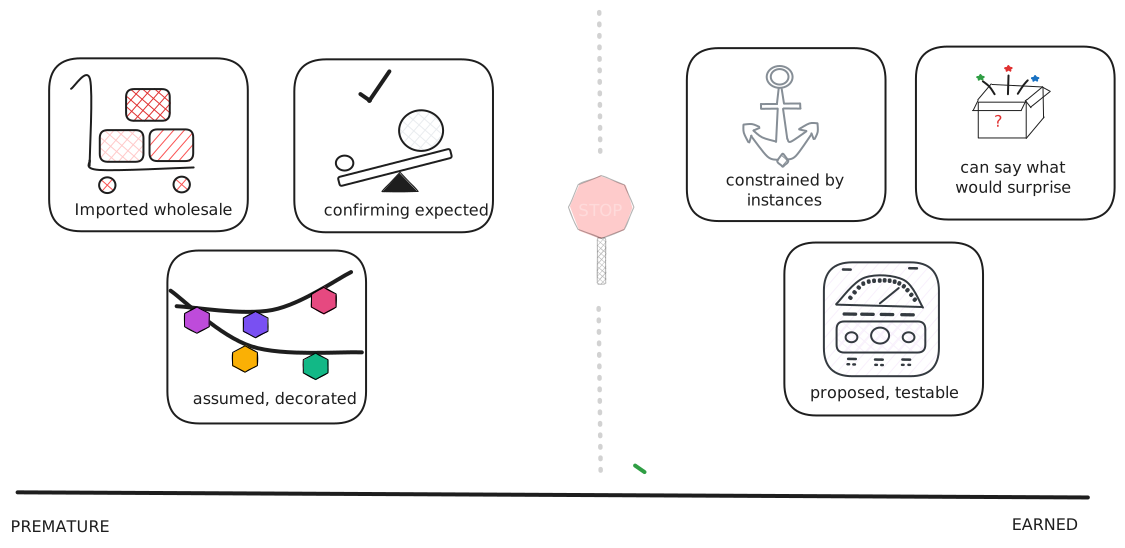
There’s no formula. But one diagnostic: could your abstraction have been written before your observations? If yes, you haven’t earned it.
The threshold isn’t a test you pass. It’s a shift you notice. From reaching for theory to having theory demanded by what you’ve seen.
The return
Abduction doesn’t end the loop. It restarts it.
A proposed structure sharpens perception. You notice things you couldn’t see before. Specifically, things that don’t fit. Anomalies. Edge cases. The places where your structure creaks.
These become new surprises. You return to immersion with a lens you didn’t have before. Collect instances that test the boundaries. The next abduction is tighter, harder to satisfy, more accountable.
The loop isn’t one pass. Understanding emerges through repeated cycling, each iteration with sharper perception and more constrained proposals.
Failure modes
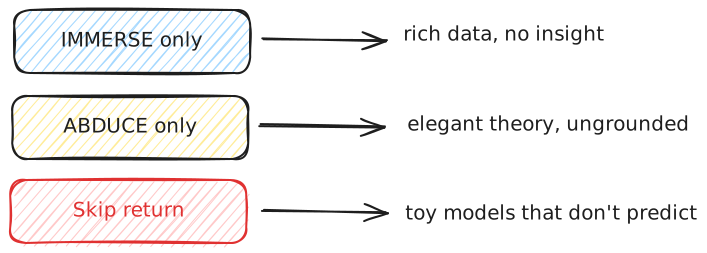
The failure mode I am most prone is the second one. The remedy isn’t abandoning abstraction. It’s earning it.