Reality is always larger than any representation we construct of it
Residual Reality
Residual Reality
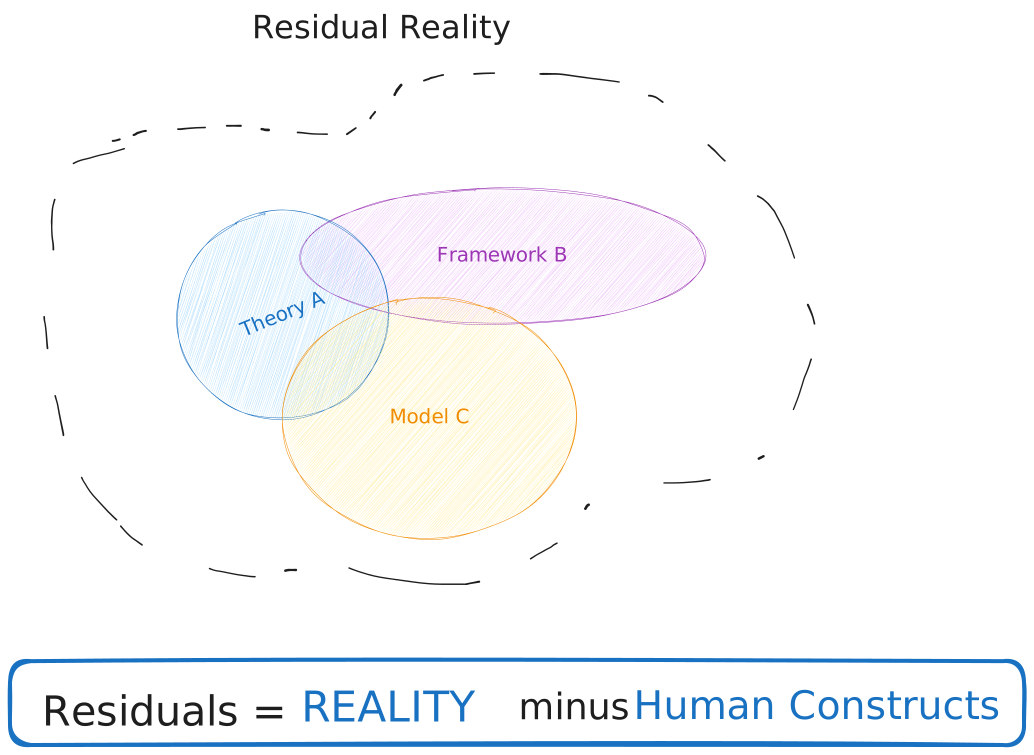
Reality is always larger than any representation we construct of it. Models and theories are tools that attach to parts of the real - capturing some aspects while necessarily leaving others out. What remains beyond any particular representation is residual reality.
This isn’t “we don’t know everything yet.” It’s structural. Any finite model of complex, stratified reality will leave residuals. Different theories carve the world at different joints, attach to different parts. No unification is coming because unification is the wrong goal.
Why This Matters to Me
I used to have this “boil the ocean” problem. Thought I needed a complete theoretical framework before I could act. Gaps in my understanding meant my tools were inadequate, so I’d read more theory, try to unify everything, never actually start. It was OCD-level coherence seeking.
Residual reality gave me philosophical permission to be pragmatic. Not by abandoning rigor, but by recognizing that completeness is structurally impossible. Tools can be adequate without being complete. Experimental cognitive science captures some mechanisms and leaves residuals. Interpretive social science captures some structures and leaves residuals. Even theoretical frameworks leave residuals. That’s not a failure - that’s how knowledge works.
This means I can move fast and learn from what breaks. Iteration reveals which aspects of reality matter for what I’m trying to do. Not progressive convergence toward completeness - just better tools for specific purposes.
“All Models Are Wrong”
You hear this constantly: “all models are wrong, but some are useful.” It never sat right with me. Like why are we leaving truth seeking for pragmatic convenience?
Residual reality makes this finally make sense. Models aren’t wrong like “false.” They’re wrong like “incomplete.” They capture real structures while leaving residuals. Theory A can be right about what it includes and still be necessarily incomplete about reality as a whole.
“Useful” doesn’t mean “pragmatically convenient even though it’s not true.” It means “adequate for specific purposes while being realist about what it captures.” The model refers to real structures. It’s just not exhaustive.
This is why residual reality isn’t anti-realism in disguise. I’m not saying models are useful fictions. I’m saying they’re partial truths about stratified reality. The incompleteness is structural, not fixable. You can’t solve it by collecting more data or building better theory - any finite representation will leave residuals.
Box’s quote works now: models are “wrong” (incomplete) and “useful” (adequate) because reality exceeds representation. Not giving up on truth. Acknowledging what truth looks like given how reality actually works.
“I take this world of ‘residual reality’ to be vastly larger than any possible representation we might construct. Accordingly, different perspectives, different languages will lead to theories that not only attach to the real in different ways (that is, carve the world at different joints), but they will attach to different parts of the real—and perhaps even differently to the same parts. (pp. 73-74)”
— Evelyn Fox Keller, quoted in Joseph Maxwell, A Realist Approach for Qualitative Research
Scientific theories are tools for intervening, not mirrors. Their effectiveness comes from adequacy for specific purposes, not completeness. A theory can be right for what you’re doing while being necessarily incomplete about reality as a whole.
What This Does
The frameworks on my Meta page contradict each other. That used to bother me - felt like I hadn’t thought things through. But they’re not competing truth claims. They’re tools that attach to different aspects of stratified reality. Predictive Processing captures some cognitive dynamics, leaves residuals. Social Facts captures some macro structures, leaves residuals. Both useful. Both incomplete.
Methodological pluralism isn’t pragmatic hedging. It’s rational. Experimental cognitive science and interpretive social science attach to different parts of residual reality. Neither is complete. Both capture different real structures.
The question isn’t “is my model complete?” It’s “does this capture the right aspects for this purpose while acknowledging what it leaves out?”